
Numbers - Advanced Settings
Setting up public telephone numbers so that anyone worldwide can contact you is a perfect way to stay connected to the outside world. Don’t forget that you can also port numbers from other providers into the platform to keep customers' existing numbers. You can add as many numbers as you wish. This can be helpful by using different numbers to track advertising campaigns or allowing customers to ring different numbers to go to different departments within a business. Numbers can be pointed to any routable service within the platform, like Telephone extensions, Hunt Groups or IVRs.
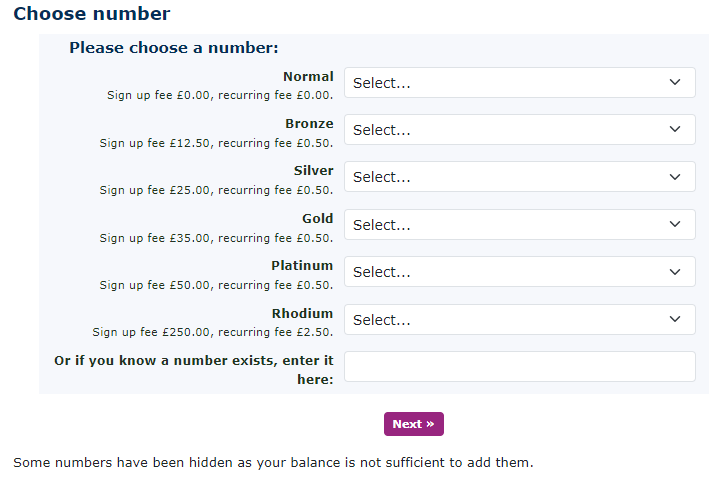
To add a number, go to Features - Numbers in the menu. Once you are in the numbering tab, press ‘New’. Choose a number via the area code name or the area code itself. Once selected, you will be offered a list of numbers available for that area. Depending on how memorable the number is will depend on the cost of the number. The better the number, the higher the price.


Number Settings
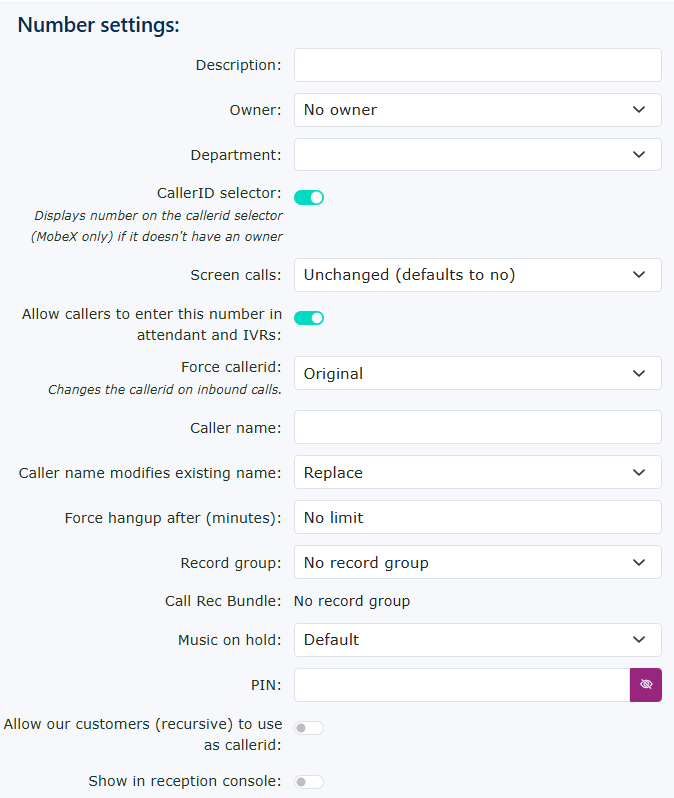
| Add a description to help identify what the number is being used for. |
|
|
|
If an owner is added here, the user who owns the number can administer it, as can the system Administrator. |
| You can assign departments to telephone numbers for improved organisation. When a department is set on a number, it will only appear in MobeX for users within the same department (or the number owner), allowing it to be selected as an outbound CLI. This helps keep number lists relevant, reduces clutter, and ensures users only see the numbers applicable to them. |
|
|
|
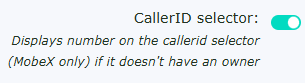
This will allow any MobeX user to select this number from the drop-down in the outbound caller number on the MobeX software, providing the option above is set to no owner. If an owner has been selected, then only that owner will see the number in their Mobex software Caller ID drop-down selector. If it has been disabled, it won't be shown, not even if an owner has been added to the number. |
|
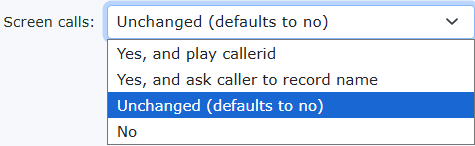
If enabled, it will play the caller's CLI and a message if you set a call screening message below. The destination will need to press 1 to accept the call. For example, it would be great if the number went off-network to a mobile device. This would give the receiving party more information about the call before they answer. |
|
|
|
You can choose ‘Yes’ or ‘No’. The default is ‘No’. If set to ‘Yes’, it will allow callers who call via an IVR or the auto attendant the ability to dial this number. |
|
When left on Original, this will show the incoming caller's number. You can force the change here if you want to show the number they called instead or even a different number within your system setup. |
|
|
|
This is a valuable box to complete. It will allow the Telephone handsets to display a name instead of the number that has been called. For example, this could be labelled as Main, Sales Line, or Internet Enquiry. |
|
You can set this to replace, prepend, or append the number called. |
|
|
|
This option can be set to force the caller to hang up after the number of minutes set here. The default is set to no limit. |
|
This option will appear if you have already added a Record Group to the system. You can select the Record Group to which you would like to add the number. There are additional features if you use the bundled call recording instead. So it may be worth looking at this first. |
|
|
|
If you have a call recording bundle set up and this number has been allocated to the group, it will show here. |
|
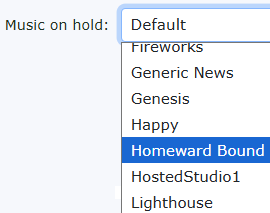
Here, you can select a different type of Music On Hold (MOH) for the caller to hear. This is a great way to share information or perhaps an advert about the company or its products.
There are plenty of default sounds pre-loaded in the system. |
|
|
|
It is used to control access when changing the number over the telephone. |
|
This allows customers under your account to use this caller ID. It is designed for customers who have a head office or multi-site company wanting to display their main office number. Not recommended to use by default. |
|
|
|
This will allow the Number to be seen in the Reception Console under the option at the top of the systems menu. |













Route Calls to
Default Destination
This is the destination of the call when you dial the number. This would typically be like a Hunt Group, Queue, or IVR.
Temporary Override
This is the call's destination when number routing is activated or a temporary forward is enabled. It would normally be different from the default destination.
Update this Number when Setting the Numbers Routing
If you select yes, and you have a time group active in the below time groups, you can use a Feature Code to switch this time group on and ‘make active’.

Announcement Message
Sound File to Use
If you have already uploaded sound files, you can select the one you wish callers to hear.
or .wav File to Upload
If you haven’t uploaded any to the platform, you can upload a WAV file here, too. This will take you to your PC and ask you to find the file you wish to upload. Once located and selected, hit the save button. Create your own audio file here. This will take you to the text-to-speech service, where you can record new announcements.

Screening message
Sound File to Use
If you have already uploaded sound files, you can select the one you wish the person who called to hear.
or .wav File to Upload
If you haven’t uploaded any to the platform, you can upload a WAV file here, too. This will take you to your PC and ask you to find the file you wish to upload. Once located and selected, hit the save button. Create your own audio file here. This will take you to the text-to-speech service, where you can record new screening announcements.


Caller Routes
A caller router recognises an incoming CLI (Caller Line Identification) and routes the call to a different destination or the default destination. The number can be a ten or 11-digit number, or you can do a partial match of a number. If you wanted to route all incoming numbers from the Birmingham area of 0121 to the Midlands district office, you could use this partial match. However, if there was a particular Birmingham number, you wanted to route it elsewhere. This would take precedence over the partial match entry.

Time Routes
Time routes are used to route calls at different times of the day or, in some cases, for manual route switching using one of the options above. Please refer to the Time Groups Section for details on setting up time groups.
When you add a new time group with a new destination, any calls will be forwarded during that time.

|
At the bottom right, you will see the other options for this number. This must be completed. Click here to switch to completing the details below. Please note that if you have extensions operating from more than one location, it is important that each location that has fixed handsets has its own emergency number and address set up.
|
|

|
|
You must complete the emergency address, as this information is sent to emergency services when anyone dials 999 or 112. You can ' use this address ' if you have completed their details already on the customer's page. This is mandatory. |

Flow Chart for Numbers
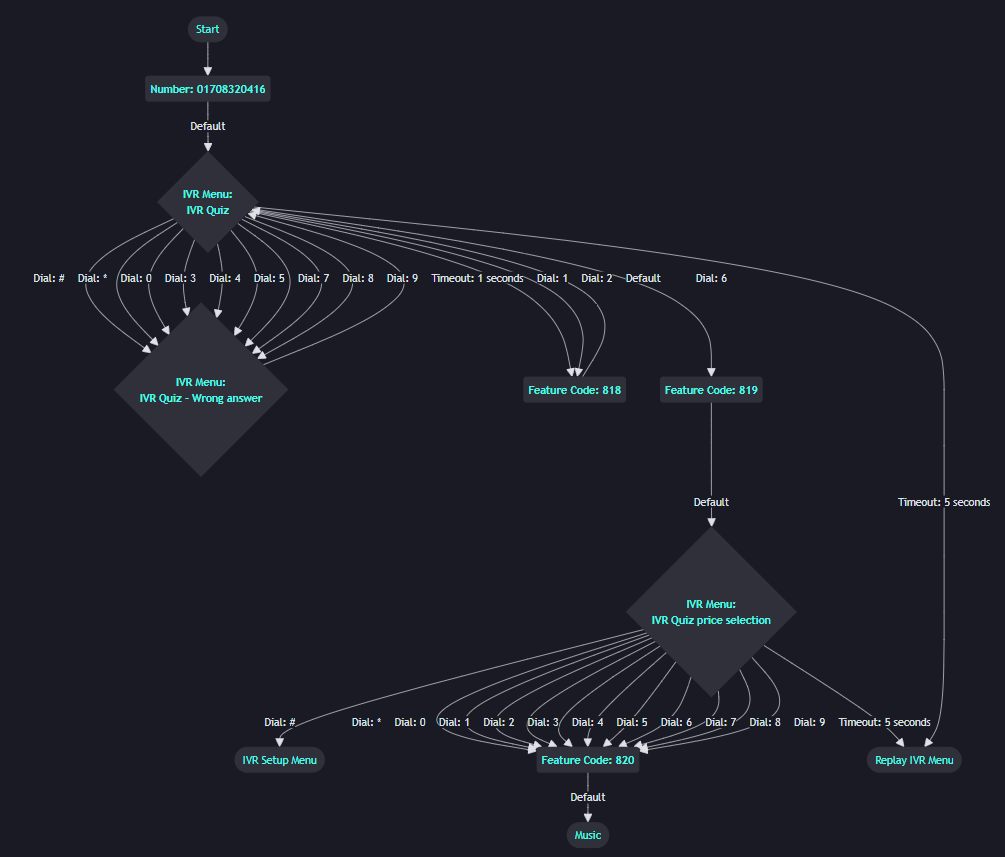
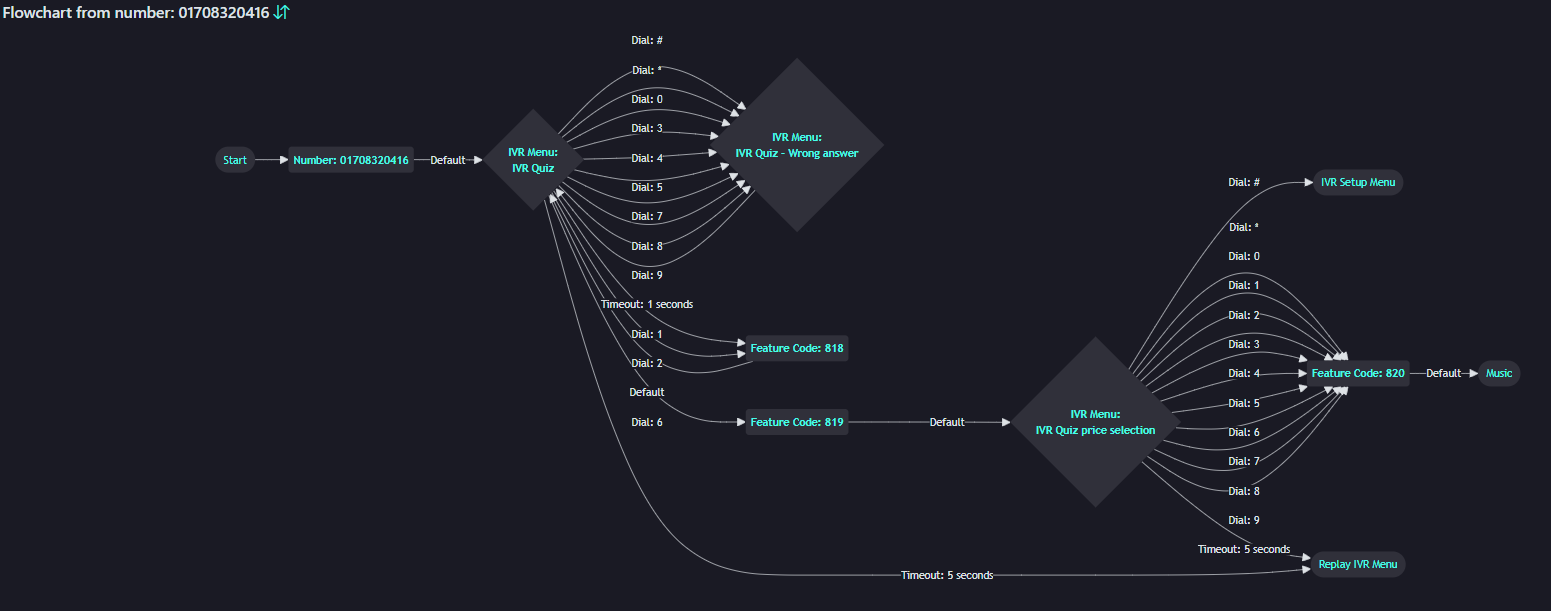
| You can see how the number is set up in a flowchart format to help you understand the routing of any calls. |
|
|
|
Click on the flow chart icon to show you the flow chart view. |
| You can also choose this direction icon to change how you see the flow. |
|
|
|
Choose between vertical and horizontal for whatever view works best for you. |


|
|
Make copy This will copy the setting you created for this current number to a new one. You must pick a new number as part of the copy process. Notes You may wish to keep some details about this number; they can be kept under 'notes' here. Web notify This is used to create an external function. See the Web notification link. |
